Drain Tile & Sewer Inspection Services in Canada
Professional CCTV Drain Tile & Sewer Inspection
Underground drainage systems are invisible infrastructure. You can't see what's happening inside your perimeter drains, sanitary sewer, or storm lines without specialized camera technology. CCTV (Closed-Circuit Television) inspection is the diagnostic foundation of modern drainage management — it reveals the actual condition of your pipes, identifies existing problems, predicts future failures, and guides cost-effective repair decisions.
Every major drainage decision should start with a CCTV inspection. Whether you're buying a home, investigating a drainage problem, planning renovations, or scheduling maintenance, the camera inspection provides objective evidence that replaces guesswork with knowledge. It's the difference between treating symptoms and diagnosing the disease.
PlumbingDrainage.ca connects property owners with qualified CCTV inspection specialists across Canada. Our network contractors use modern HD camera systems with distance counters, pan-and-tilt heads, and digital recording. Every inspection includes a full video recording, written condition assessment, and prioritized recommendations.
How CCTV Inspection Works
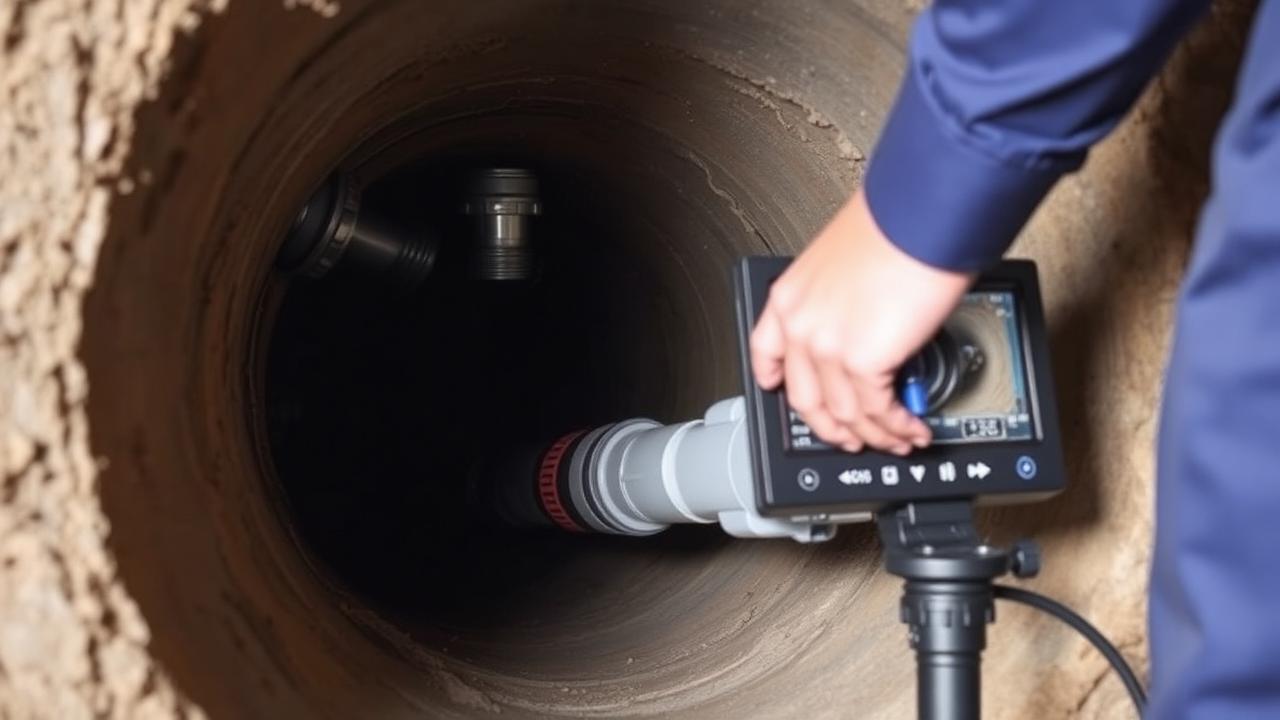
A waterproof, high-definition camera is mounted on a flexible push rod or motorized crawler and fed into the drainage system through an access point — typically a cleanout, catch basin, or drain opening. The camera transmits real-time video to a monitor above ground, allowing the technician to examine the interior condition of pipes as the camera advances through the system.
Modern inspection cameras include several critical features. Distance counters track exactly how far the camera has traveled from the access point, enabling precise location of defects. Pan-and-tilt heads allow 360-degree viewing of the pipe interior, not just the forward view. Self-levelling cameras keep the image oriented correctly regardless of pipe slope. LED lighting illuminates the pipe interior for clear imaging even in the darkest conditions.
The technician records the entire inspection on digital video, noting the location and nature of each defect, condition change, or concern. This video becomes a permanent record that can be compared to future inspections to track changes over time. It also serves as documentation for insurance claims, real estate transactions, and contractor quality verification.
What the Camera Reveals
CCTV inspection identifies a comprehensive range of drainage conditions and defects that are impossible to detect from above ground.
- Root intrusion at pipe joints and through cracks — from minor infiltration to complete blockage
- Pipe cracks, fractures, and breaks — hairline to structural failure
- Joint separation and offset — where pipes have shifted out of alignment
- Bellied or sagging sections that trap water and debris
- Scale buildup from minerals, grease, and biological growth
- Pipe material identification and wall thickness assessment
- Corrosion in cast iron and ductile iron pipes
- Orangeburg (bituminous fibre) pipe deterioration
- Clay pipe degradation and joint failure
- Ground settlement effects on pipe alignment
- Cross-connections and improper tie-ins
- Missing cleanouts or inaccessible access points
- Pipe diameter changes and transition fittings
- Backfall (sections sloped the wrong direction)
- Infiltration (groundwater entering the pipe through defects)
When to Schedule a CCTV Inspection
CCTV inspection is valuable in numerous situations, from routine monitoring to emergency diagnostics.
Real Estate Transactions
A pre-purchase sewer scope and drain tile inspection should be as standard as a home inspection for any property purchase. The cost of inspection ($250-$600) is trivial compared to the cost of undiscovered drainage problems. In competitive real estate markets, some buyers skip this step and later face $10,000-$25,000 in unexpected drainage repairs.
For sellers, a pre-listing inspection demonstrates transparency and can prevent sale complications. If problems are found, you can either repair them or price the property accordingly, avoiding last-minute renegotiation that often costs more than proactive repair.
Recurring Drainage Problems
If you experience repeated slow drains, gurgling sounds, sewage odours, or periodic backups, a CCTV inspection identifies the underlying cause. These symptoms often indicate structural pipe problems that cleaning alone won't resolve — root intrusion at a failed joint, a bellied section trapping debris, or pipe deterioration that will only worsen with time.
Pre-Renovation Assessment
Before adding bathrooms, extending drainage lines, or connecting new construction to existing systems, CCTV inspection reveals the condition and capacity of existing infrastructure. Connecting new fixtures to deteriorating pipes creates immediate problems. Knowing the existing system's condition lets you plan upgrades concurrent with renovation, saving significant cost over separate projects.
Strata and Multi-Unit Buildings
Strata buildings should schedule CCTV inspection of common drainage infrastructure annually or biennially. Shared sanitary mains, storm drainage, and perimeter drain systems serve all units, and failure affects multiple owners. Annual inspection identifies developing problems before they cause multi-unit damage and allows the strata council to budget for repairs proactively.
Post-Event Assessment
After significant events — major storms, ground movement, nearby construction, or tree removal — CCTV inspection assesses potential impact on underground pipes. Construction vibration, tree root decomposition, and soil saturation can all damage buried piping. Early detection prevents emergency failures.
Baseline Documentation
Even without specific concerns, establishing a baseline CCTV record of your drainage system's condition is valuable. Future inspections can be compared to the baseline to track changes, deterioration rates, and emerging problems. This is particularly important for newer homes where you want to document initial conditions before warranty periods expire.
Insurance Documentation
Many insurance claims related to drainage require documentation of system condition. A CCTV inspection conducted before a claim event demonstrates the system was in good condition and the damage resulted from a specific event rather than chronic neglect. Post-event inspection documents the damage for claim support.
Drain Tile Inspection: Protecting Your Foundation
Drain tile (perimeter drain or weeping tile) inspection is a specialized subset of CCTV inspection that focuses on the drainage system protecting your foundation. This system is buried six to eight feet underground, wrapped around your foundation footings, and is impossible to assess without camera technology.
Why Drain Tile Inspection Is Critical
Drain tile systems have finite lifespans. Systems installed before 1970 using clay tile typically last 40-60 years. Systems from the 1970s-1990s using early corrugated plastic pipe last 25-40 years. Even modern PVC systems, while more durable, can fail due to installation defects, ground movement, or root intrusion.
When drain tile fails, groundwater pressure against your foundation increases. Water finds every crack, joint, and pore in the concrete. Basement moisture, then seepage, then active water infiltration follow. By the time you see water in your basement, the drain tile may have been failing for months or years.
CCTV inspection of drain tile reveals the current condition and predicted remaining life of the system. A single inspection can save you from thousands of dollars in water damage or prevent you from prematurely replacing a system that has years of life remaining.
The Drain Tile Inspection Process
Drain tile inspection requires specialized equipment and expertise beyond standard sewer camera work. The access points are typically limited — usually through cleanouts at foundation corners or through the sump pit. The pipe diameter is smaller (typically 4 inches), requiring compact camera systems. And the pipe layout follows the foundation perimeter with multiple 90-degree bends that require flexible, push-type cameras.
The inspection covers the entire accessible length of the perimeter drain, noting pipe material, condition, joint integrity, sediment accumulation, root presence, and any structural defects. The technician documents the location of each finding relative to the foundation, allowing targeted repair if needed rather than full system replacement.
Common Drain Tile Problems by Era
Homes built before 1960 may have clay tile drain systems — actual ceramic tiles laid end-to-end with gaps for water entry. These systems rely on gravity and have no filter fabric, leading to heavy sediment accumulation and root intrusion at every joint. Most clay tile systems are past their expected lifespan and warrant replacement.
Homes built 1960-1990 typically have corrugated polyethylene (CPE) drain tile with perforations. These systems improved on clay tile but still suffer from collapse under soil pressure, sediment blockage, and root intrusion. Many are approaching or past their expected lifespan.
Homes built after 1990 generally use rigid PVC or modern heavy-duty corrugated PE with filter fabric wrapping. These systems are more durable but can still experience problems from installation defects, inadequate gravel bed, missing or deteriorated filter fabric, and root intrusion at connections.
Reading the Inspection Report
A professional drain tile inspection report should include the pipe material and approximate age, overall condition rating (good, fair, poor, failed), specific defects with location measurements, sediment level assessment as a percentage of pipe capacity, root intrusion presence and severity, photo captures of significant findings, and recommendations prioritized by urgency.
Understanding the report helps you make informed decisions. A system rated "fair" with moderate sediment may benefit from cleaning and monitoring rather than immediate replacement. A system rated "poor" with multiple structural defects needs replacement planning — but you may have months to budget and schedule rather than facing an emergency.
Sewer Line Inspection: What to Expect
Sanitary sewer inspection examines the pipe carrying wastewater from your home to the municipal main at the property line. This is typically the most critical single pipe on your property — when it fails, nothing drains.
Typical Sewer Inspection Procedure
The inspection begins at the most upstream accessible point — usually a main cleanout inside the home or at the foundation wall. The camera advances downstream toward the municipal connection, with the technician recording the entire journey. Key observations include pipe material transitions (many homes have multiple pipe materials from different eras of repair), joint conditions, root presence, deposits, and structural integrity.
The camera should reach the municipal connection point if possible. This establishes the total pipe length, confirms the connection condition, and identifies any problems near the property line — the most expensive location to repair due to depth and proximity to municipal infrastructure.
Common Sewer Line Findings
Root intrusion is the most common finding, especially in established neighbourhoods with mature trees. Roots enter through joints and cracks, initially as fine filaments that progressively thicken into dense masses that trap debris and restrict flow. Root severity is graded from minor infiltration (manageable with periodic cutting) to complete obstruction (requiring repair or replacement).
Pipe material deterioration varies by type. Cast iron pipes corrode internally, building tuberculation (rough nodules) that reduces flow capacity and eventually penetrates the pipe wall. Clay pipes develop joint cracks and separations from ground movement. Orangeburg pipes (used from the 1940s through the 1970s) delaminate and collapse, and are considered universally failed when found. ABS plastic from early installations can become brittle and crack. Only PVC and modern HDPE pipes resist most degradation mechanisms.
Bellied sections — where a length of pipe has sagged due to soil settlement — trap water and debris, creating recurring blockage points. Minor bellies may be manageable with periodic cleaning, but severe bellies that retain standing water usually require excavation and releveling or replacement.
Cost-Benefit of Sewer Inspection
A standard residential sewer inspection costs $250-$500. For this investment, you receive a complete assessment of your most critical drainage infrastructure. Compare this to the potential consequences of undiagnosed problems: emergency sewer repair ($3,000-$15,000), sewer line replacement ($8,000-$25,000), sewage backup cleanup ($5,000-$20,000), and content damage that may not be covered by insurance.
For real estate transactions, the inspection cost is negligible relative to property values. A $400 inspection that reveals a $15,000 sewer problem before you buy saves $14,600 — or gives you negotiating leverage that often exceeds the repair cost.
Advanced Inspection Technologies
CCTV inspection technology continues to evolve, with new capabilities that provide more detailed and actionable diagnostic information.
Lateral Launch Cameras
Conventional CCTV cameras inspect the main pipe they're fed into. Lateral launch cameras include a secondary camera on an articulated arm that can be deployed into branch connections while the main camera remains in the main line. This technology allows inspection of fixture connections, branch lines, and lateral connections without separate access points.
Sonar Profiling
For pipes partially or fully submerged in water — common in storm drainage and combined sewers — sonar profiling provides cross-sectional imaging that the camera cannot. Sonar measures pipe diameter, identifies deformation, quantifies sediment deposits, and detects voids behind the pipe wall. Combined with CCTV, sonar provides a complete picture of submerged pipe conditions.
Pipe Condition Assessment Standards
Professional inspection follows standardized condition assessment protocols. In Canada, the Pipeline Assessment Certification Program (PACP) and the Western Canadian standards provide consistent grading criteria for pipe defects. Defects are coded by type, severity, and location, producing standardized reports that can be compared across inspections and contractors.
Using a certified inspector who follows these standards ensures your report is credible for insurance claims, engineering assessments, legal disputes, and regulatory compliance. Non-standardized reports may not be accepted by insurers or municipalities.
Electronic Locating
When a CCTV inspection identifies a defect, the next question is: where exactly is it? Electronic locating uses a transmitter (sonde) built into the camera head and a receiver (locator) above ground to pinpoint the camera's position. The technician marks the surface location directly above the defect, measures the depth, and records the coordinates. This information guides repair excavation to the exact location, minimizing unnecessary digging and landscape disruption.
3D Mapping and Digital Twins
Emerging technology allows CCTV inspection data to be processed into 3D models of drainage systems. These digital twins provide precise pipe routing, grade information, defect locations, and condition mapping in a visual format that's intuitive for property owners and engineers. While not yet standard for residential inspections, this technology is increasingly used for commercial and municipal infrastructure assessment.
Reporting Software
Modern inspection software generates reports that include video clips linked to specific defect locations, photo captures with annotations, pipe condition ratings using standardized scales, GIS mapping of pipe routes and defect locations, comparison overlays with previous inspections, and prioritized repair recommendations with cost estimates. This comprehensive reporting transforms raw camera footage into actionable decision-making tools.
Choosing a CCTV Inspection Contractor
The quality of a CCTV inspection depends entirely on the operator's expertise and equipment. An experienced technician with modern equipment will identify problems that a less qualified operator would miss, and will provide reports that support informed decision-making.
Equipment Standards
Minimum equipment standards for a quality inspection include HD resolution cameras (at minimum 720p, preferably 1080p), built-in distance counter accurate to 0.1 metres, pan-and-tilt head for 360-degree viewing, self-levelling capability, adequate LED lighting for clear imaging, digital recording with time and distance stamps, and electronic locating capability for defect pinpointing.
Push cameras (flexible rod systems) are standard for residential drain tile and sewer inspection up to 200 feet. For longer runs or larger diameter pipes, crawler-mounted cameras provide better image stability and longer range. A well-equipped contractor should have both systems available.
Operator Qualifications
CCTV inspection is a skilled trade. Experienced operators recognize subtle defect indicators that less experienced operators miss — hairline cracks barely visible in the image, slight changes in pipe material colour indicating corrosion thinning, minor joint offsets that predict future failure, and early-stage root intrusion that's easily overlooked.
Ask about the operator's experience and training. How many inspections have they performed? Do they hold PACP certification or equivalent? Can they demonstrate the difference between cosmetic issues and structural concerns? A qualified operator doesn't just run the camera — they interpret what it shows and communicate findings clearly.
Report Quality
The inspection report is the deliverable you're paying for. A quality report includes complete video coverage of the entire inspected length, photo captures of all significant findings with annotations, written condition assessment for each pipe section, defect coding using standardized criteria, pipe material and approximate age identification, overall system condition rating, prioritized recommendations with urgency levels, and estimated repair costs when appropriate.
Avoid contractors who provide only verbal assessments or raw video without written interpretation. You need documentation that can be shared with other professionals, submitted to insurers, and referenced in the future.
PlumbingDrainage.ca Standards
Contractors in the PlumbingDrainage.ca network meet minimum equipment and qualification standards for CCTV inspection. Our directory identifies contractors' inspection capabilities, camera systems, and specializations, helping you find the right inspector for your specific needs — whether that's a pre-purchase sewer scope, a comprehensive drain tile assessment, or a commercial infrastructure survey.
Frequently Asked Questions
How much does a CCTV drain inspection cost?
Residential sewer inspections typically cost $250-$500 for a standard camera run. Drain tile (perimeter drain) inspections run $300-$600. Combined inspection of sewer and drain tile provides the best value at $500-$900. Commercial and strata inspections are quoted based on system size and complexity.
How long does a drain inspection take?
A standard residential sewer inspection takes 30-60 minutes. Drain tile inspection takes 45-90 minutes due to the longer pipe length and multiple access points. Combined inspections typically complete in 1.5-2.5 hours. You'll receive the video recording and report on-site or within a few business days.
Do I need a sewer inspection before buying a house?
Absolutely. A pre-purchase sewer scope is one of the most important inspections you can commission. Sewer line replacement costs $8,000-$25,000, and drain tile replacement costs $8,000-$20,000. A $400-$600 inspection that discovers these problems before closing is invaluable.
What happens if the inspection finds problems?
The inspection report includes prioritized recommendations. Some findings are minor and can be monitored. Others require maintenance (cleaning, root cutting) rather than repair. Structural problems are categorized by urgency — some need immediate attention while others can be planned and budgeted over months or years.
Can CCTV cameras inspect all pipe types?
Yes — CCTV cameras inspect clay, concrete, cast iron, Orangeburg, ABS, PVC, HDPE, and corrugated polyethylene pipes. Different pipe materials present different challenges and defect patterns, which experienced operators recognize and report accurately.
How often should drain tile be inspected?
For homes over 25 years old, inspect drain tile every 3-5 years. For homes with known drainage issues or older pipe materials, annual inspection is recommended. Strata buildings should inspect common drain tile systems annually or biennially as part of their maintenance program.
Seasonal homeowner guides
Get ready for winter 2026–2027
Practical checks for cold weather, heavy rain and the spring thaw. Start with the guide that fits your home.
Find a Drainage Professional
Connect with qualified contractors in your area through PlumbingDrainage.ca.
View All Services